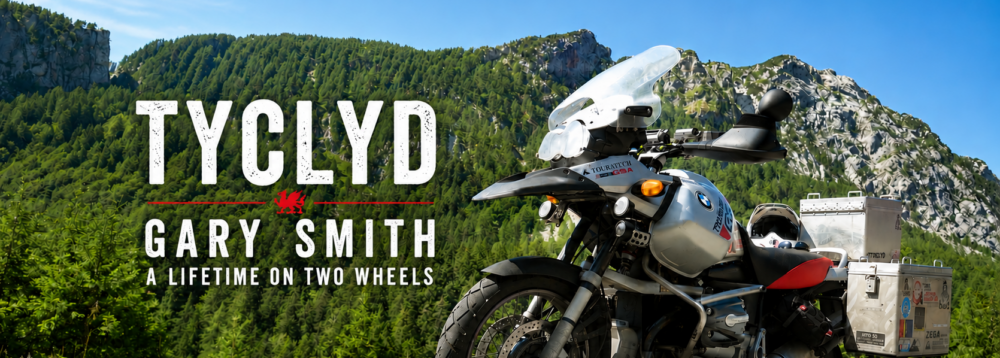
The new Africa Twin is bigger, more powerful and more sophisticated than ever. But after owning the original CRF1000L DCT and discovering just how much fun a little CRF300L can be, I can’t help wondering whether Honda has forgotten what adventure motorcycling is really about.
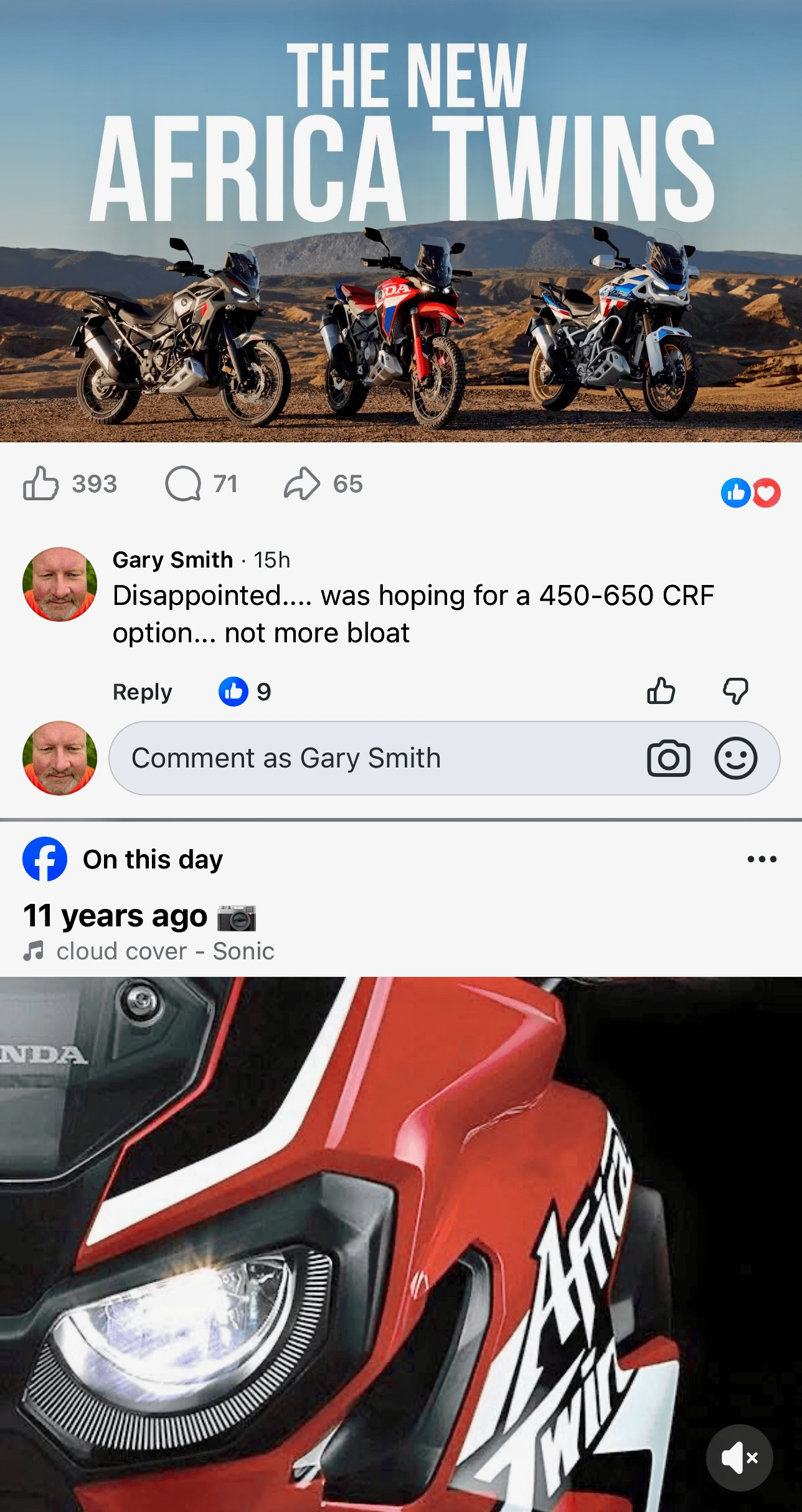
Yesterday, Honda announced its latest Africa Twin range for 2027. Three new models, a larger engine, more power, sophisticated electronic suspension and, on the flagship Adventure Sports, radar-assisted technology. An extraordinary achievement in motorcycle engineering.
And my overwhelming reaction? Disappointment.
I’d been hoping for something quite different. A proper mid-capacity adventure motorcycle, perhaps between 450 and 650cc, with reasonable weight, decent suspension, useful fuel range and enough power to cover motorway miles comfortably. Instead, Honda has given us another generation of increasingly sophisticated, expensive and physically substantial adventure motorcycles. I can’t help thinking they’ve lost their way.
It wasn’t always like this The Africa Twin story began in 1988 with the XRV650, inspired by Honda’s success in the Paris–Dakar Rally. Its 647cc V-twin produced around 57 bhp, with a substantial fuel tank, long-travel suspension and an engine renowned for durability. At around 220 kg ready to ride, it wasn’t particularly light, but it was a beautifully straightforward proposition.
The 750cc Africa Twin that followed developed the same philosophy: strong, capable, relatively simple and designed to keep going. These were dependable motorcycles that could carry you and your luggage over enormous distances, cope with indifferent roads and venture off the tarmac without requiring a degree in electronics.
Eleven years ago, I bought the new Africa Twin When Honda announced the revival of the Africa Twin in 2015, I was excited enough to buy one. The CRF1000L seemed to represent a welcome return to the original philosophy: a 998cc parallel twin, sensible power output, proper off-road wheel sizes and the promise of a reliable, modern adventure motorcycle.
I chose the DCT version. Honda’s dual-clutch transmission worked impressively well, and the motorcycle was undoubtedly competent. But I never really connected with it. It was, for want of a better word, soulless. Everything worked, everything was efficient, but there was precious little that made me fall in love with it.
Then there was the fuel range. In my experience, I was getting around 120 miles from a tank before needing to think seriously about fuel. For a motorcycle carrying the Africa Twin name, I found that astonishingly disappointing. Here was a machine supposedly designed for long-distance adventure, yet I was constantly conscious of where the next petrol station might be. I sold it a few years later. I’ve never particularly missed it.

Look at what Honda has announced The new 2027 CRF1150L Africa Twin has a 1,131cc parallel-twin engine producing approximately 117 bhp and 119 Nm of torque. There are three models: the standard Africa Twin, the touring-oriented Adventure Sports and a new Enduro Sports intended to offer improved off-road performance. Honda has clearly put considerable engineering effort into the design. The chassis is lighter, the centre of gravity has been lowered and the new Enduro Sports incorporates suspension technology derived from Honda’s rally machines. These are worthwhile improvements, but look at the bigger picture.
The lightest new Africa Twin still weighs 228 kg fully fuelled. The top-specification Adventure Sports weighs 256 kg. That’s a quarter of a tonne of motorcycle, with electronically controlled suspension, multiple riding modes, traction control, wheelie control, cruise control and, on the flagship, radar-based rider assistance.
As an engineer and having ridden bikes for more that 50 years, I appreciate the technology. Some of it is fascinating. But I also find myself asking a very simple question: what problem are we actually trying to solve? Because on the narrow, twisting roads of Mid Wales, I can assure you that 117 bhp and a quarter of a tonne of motorcycle aren’t essential ingredients for a good day’s riding. In fact, they can make the experience considerably less enjoyable.
Which brings me to the motorcycle that has reminded me what this is really about. My Honda CRF300L. A modest 286cc single-cylinder machine producing about 27 bhp, with basic electronics, straightforward mechanicals and a comparatively featherweight 142 kg in standard form. I’ve fitted an Acerbis long-range fuel tank, addressing one of its most obvious limitations.
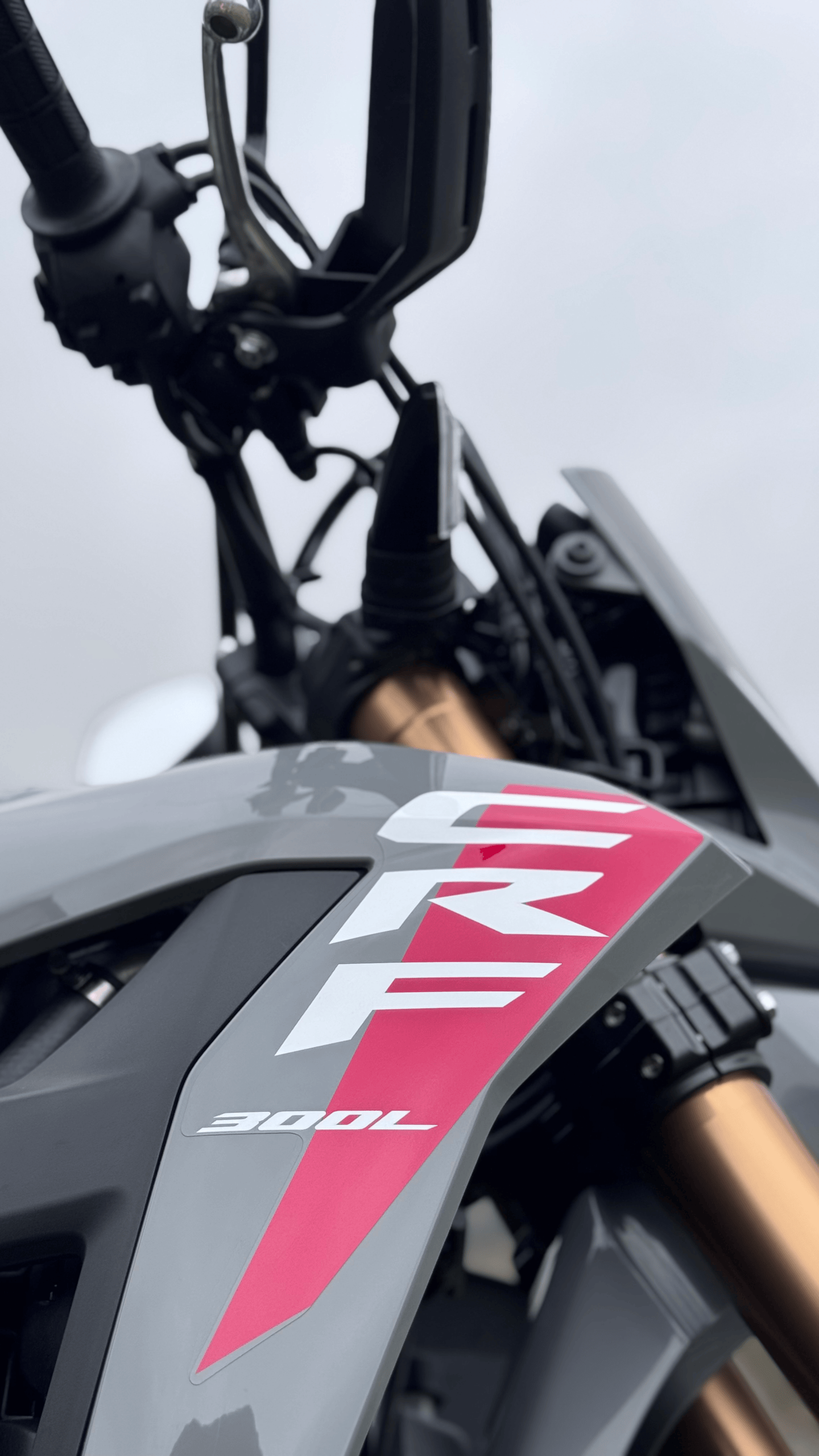
And I absolutely love it. There’s something liberating about riding a motorcycle that doesn’t intimidate you with its weight or dimensions. You can flick it through corners, explore narrow lanes, turn around on awkward tracks and generally go wherever curiosity takes you. It’s not particularly fast, but it doesn’t need to be. You’re simply riding, enjoying the road, the scenery and that wonderful connection between rider and machine.
Of course, the CRF300L isn’t perfect. It’s not my first choice for hundreds of motorway miles, its suspension is fairly basic and there’s only so much performance you can expect when carrying luggage. But the fundamentals are right: it’s manageable, economical, reliable and fun.
In many respects, my little CRF300L delivers more of what I want from an adventure motorcycle than my Africa Twin ever did. And that ought to tell Honda something.
Somewhere in the middle is a missing motorcycle.
I’m not suggesting everyone should abandon large adventure bikes and buy a 300cc trail bike. There are obvious advantages to a bigger machine, particularly when carrying a pillion, luggage or covering substantial motorway distances. Surely there’s a sensible middle ground?
A motorcycle with perhaps 450–650cc, producing around 50–65 bhp. Enough power to cruise comfortably at motorway speeds, overtake without drama and carry luggage without constantly working the engine, but light enough to enjoy the lanes and backroads where so much of the pleasure of motorcycling is found.
I’d like a genuine ready-to-ride weight below 190 kg, ideally closer to 180 kg, a fuel range of at least 250 miles, decent adjustable suspension, a comfortable seat and useful wind protection. Reliable fuel injection, sensible ABS and good brakes. Beyond that, I’d rather Honda spent its engineering effort reducing weight and improving the fundamentals than adding another layer of electronic sophistication.
It doesn’t need to be built down to a price. I’d happily pay for high-quality components and thoughtful engineering. I simply want the money spent where it matters. The Chinese bikes are nipping very hard at Honda’s heels.
Weight is the enemy of enjoyment…
Modern adventure motorcycles can feel wonderfully manageable once moving. At 70 mph, a 250 kg machine can be remarkably stable and effortless. But the weight hasn’t disappeared. Try turning around on a steep, cambered Welsh lane covered in loose gravel, manoeuvring on uneven ground or picking it up after an innocent low-speed tumble. Suddenly, all that impressive engineering is still attached to a quarter of a tonne of metal.
And for ordinary mortals, particularly those of us who have been riding for decades and no longer feel the need to prove anything, that’s a significant consideration.
The confidence that comes from riding something lighter changes your relationship with the road. You’re more inclined to explore, more willing to take an unfamiliar turning and less concerned about what lies around the next corner. Surely that’s what adventure motorcycling should encourage?
Perhaps the industry is solving the wrong problem
Honda isn’t alone. BMW, KTM, Ducati and others have spent years competing to produce ever more powerful, technically sophisticated and expensive adventure motorcycles. Clearly there’s a market for them, and I don’t doubt the new Africa Twin will be an excellent machine for many riders.
But there’s something slightly absurd about designing increasingly complicated technology to make a very large motorcycle feel manageable, when another solution might simply be to build a smaller, lighter motorcycle in the first place.
The real engineering achievement would be a genuinely capable middleweight adventure bike that delivers its performance through intelligent design, low weight and quality components rather than ever-increasing capacity and electronic assistance.
A motorcycle that can cross Europe comfortably, tackle the backroads of Wales with enthusiasm and continue along a rough track without its rider worrying about the consequences. Not a competition enduro or a miniature superbike on stilts, but a dependable, go-anywhere travelling motorcycle.
The unicorn motorcycle
Motorcyclists have been talking about the mythical unicorn adventure bike for years. Light enough to be enjoyable, powerful enough for touring, comfortable enough for long journeys, strong enough to carry luggage, simple enough to maintain and with sufficient fuel range to explore without constantly hunting for petrol.
The irony is that Honda already has much of the necessary expertise. The CRF300L demonstrates that it can build a delightful, lightweight dual-purpose motorcycle. The Africa Twin demonstrates that it understands long-distance adventure touring. Surely Honda can bring the best qualities of the two together?
I don’t want another 1,100cc technological showcase. I want a motorcycle that makes me smile every time I ride it. My little CRF300L does that more convincingly than the Africa Twin DCT I bought eleven years ago ever managed.
Honda, you’ve lost your way
I don’t believe the new Africa Twin is a bad motorcycle. Far from it. It may well be one of the most capable large adventure motorcycles ever produced. But I do believe Honda has become caught up in an industry obsession with bigger engines, more features, greater sophistication and increasingly premium positioning.
I’m not asking Honda to recreate the past. I’m asking it to remember what made those earlier motorcycles so appealing: dependability, simplicity, practicality and freedom.
Give us a 450–650cc adventure bike with a proper fuel tank, decent suspension, a comfortable seat and enough power to get us wherever we want to go. Keep it light, keep it simple and make it a motorcycle that ordinary people can confidently ride on ordinary roads as well as extraordinary ones.
Because after all these years, I’ve come to realise something. The best adventure motorcycle isn’t the one that can do the most. It’s the one that makes you want to go out and do more. And right now, Honda, that’s my little CRF300L. Not your quarter-tonne flagship. Perhaps it’s time to rediscover what adventure is really about.