
The Honda CBX750 engine, introduced in 1984, was one of Honda’s finest middleweight four-cylinder engines. Designed as a modern replacement for the ageing CB750, the Honda CBX750 engine combined smoothness, reliability and impressive performance with the refinement that had become synonymous with Honda engineering. This page looks at the design of the CBX750 engine, how it worked, what made it special and what it was like to live with. This is my CBX750…
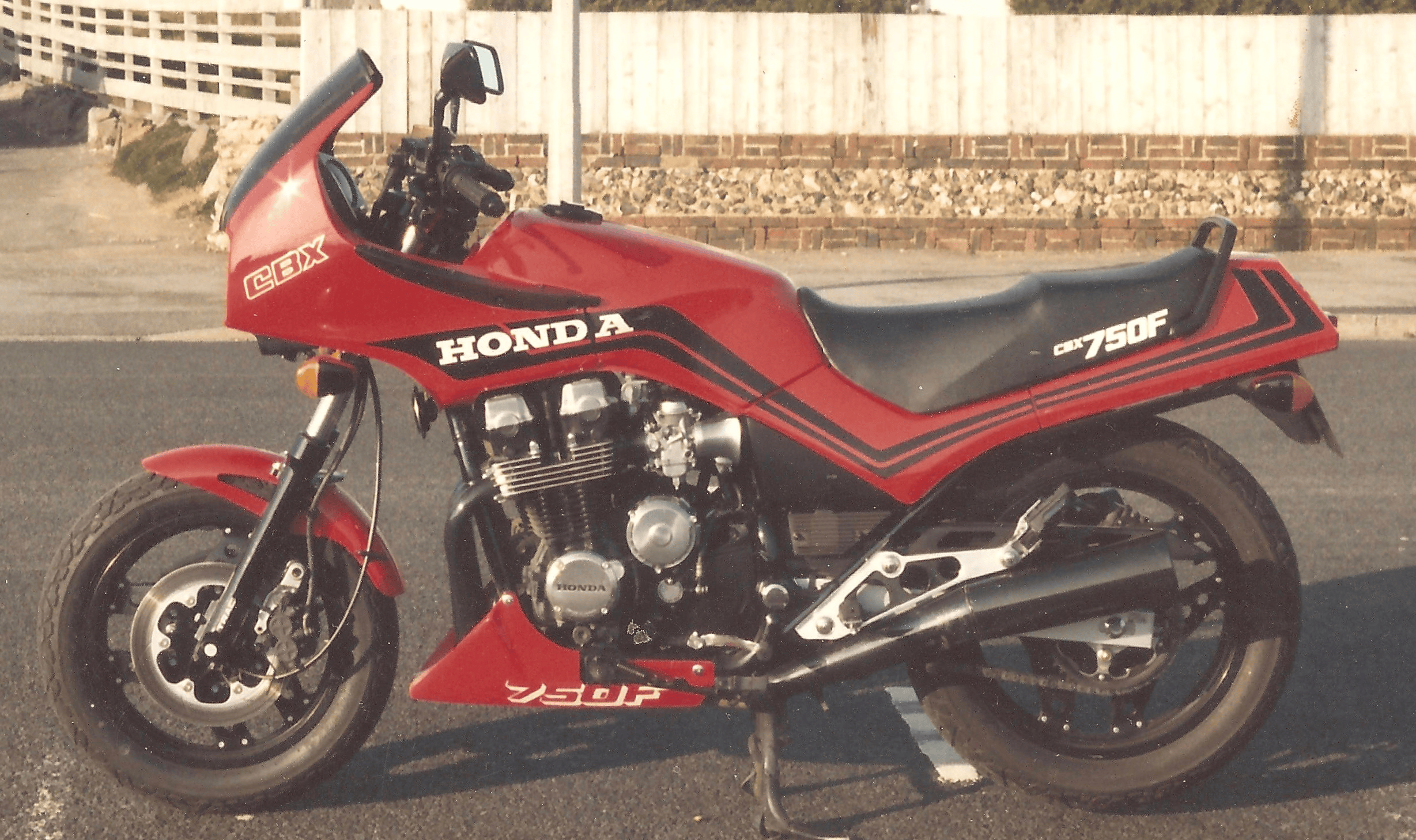
| Specification | CBX750 |
|---|---|
| Capacity | 747 cc |
| Cylinders | Inline four |
| Cooling | Liquid |
| Valve gear | DOHC, 16 valves |
| Carburettors | Four Keihin CV |
| Power | 91 bhp |
| Torque | 47 lb ft (approx.) |
| Gearbox | Six speed |
Honda CBX750 Engine Design
The CBX750 engine was designed during a period when motorcycle manufacturers were moving rapidly towards liquid cooling, multi-valve cylinder heads and higher engine speeds. Honda wanted an engine that offered significantly better performance than the ageing SOHC CB750 while retaining the reliability and refinement that had become synonymous with the Honda name.
Rather than chasing outright horsepower at the expense of usability, Honda’s engineers produced an engine that delivered strong performance throughout the rev range. The result was an exceptionally smooth power unit that was equally at home commuting through town, touring across Europe or cruising effortlessly at motorway speeds.
Unlike many contemporary sports bikes, the CBX750 never felt highly strung. Instead, it combined impressive acceleration with remarkable civility, making it one of the most versatile motorcycles of the mid-1980s.

Double Overhead Camshaft Cylinder Head
One of the CBX750’s biggest advances was its modern double overhead camshaft (DOHC) cylinder head.
Each cylinder employed four valves—two inlet and two exhaust—operated directly by twin camshafts. Compared with Honda’s earlier two-valve engines, this arrangement greatly improved breathing efficiency, allowing the engine to ingest more air and expel exhaust gases more effectively.
Valve actuation used shim-under-bucket tappets, a system renowned for its durability and stability at high engine speeds. Once correctly adjusted, valve clearances tended to remain stable for many thousands of miles, reducing routine maintenance requirements.
The sixteen-valve layout also produced a compact combustion chamber, improving combustion efficiency, throttle response and fuel economy while contributing to the engine’s excellent reliability.
Liquid Cooling
Unlike the original CB750, the CBX750 employed a fully liquid-cooled engine.
Water circulated through jackets cast into the cylinder block and cylinder head before passing through a front-mounted radiator. This maintained a consistent operating temperature under all riding conditions and eliminated many of the problems associated with large air-cooled engines, particularly when ridden slowly in heavy traffic or during hot summer weather.
Liquid cooling also enabled Honda to use tighter engineering tolerances, improving durability, reducing mechanical noise and allowing higher performance without compromising reliability.
Fuel and Induction
Fuel was supplied by four constant-velocity (CV) Keihin carburettors, one for each cylinder.CV carburettors were chosen because they provided exceptionally smooth throttle response throughout the rev range. Rather than relying solely on throttle position, the vacuum-operated slides adjusted automatically to engine demand, producing clean acceleration with very little hesitation.When correctly balanced, the four carburettors contributed significantly to the CBX750’s reputation for turbine-like smoothness.

Power Delivery
The CBX750’s engine was not simply about peak horsepower. Its greatest strength was the way it delivered that power.
Torque was available from surprisingly low engine speeds, allowing relaxed riding without constant gear changes, while the engine remained eager to rev beyond 9,000 rpm when more spirited performance was required.
Unlike many high-performance motorcycles of the period, there was no dramatic surge of power. Instead, acceleration built progressively and predictably, giving the rider complete confidence whether overtaking, touring or simply enjoying a favourite stretch of twisting road.
Honda CBX750 Engine Reliability
One reason the CBX750 enjoys such a loyal following is its mechanical durability. Routine servicing consisted mainly of:
- regular oil and filter changes
- valve clearance inspection
- carburettor balancing
- coolant replacement
- cam chain inspection
Provided these tasks were carried out at the recommended intervals, engines regularly exceeded very high mileages without requiring major internal repairs.
Like many motorcycles of its age, the carburettors can suffer from blocked jets if left standing for long periods, while neglected cooling systems may develop corrosion or leaking hoses. However, these are age-related issues rather than design faults.
Overall, the CBX750 engine earned an enviable reputation for reliability and remains one of Honda’s most dependable four-cylinder power units.
Riding Character
The CBX750 engine perfectly embodied Honda’s engineering philosophy of the period. It was refined rather than aggressive, effortless rather than intimidating.
At lower engine speeds it pulled cleanly and smoothly with virtually no vibration, making everyday riding remarkably relaxing. Open the throttle harder and the engine transformed into an eager, free-revving four-cylinder that produced a distinctive induction howl while retaining the smoothness for which Honda engines are famous.
The six-speed gearbox complemented the engine beautifully, with light, positive gear changes encouraging riders to make full use of the engine’s wide power band. Whether covering hundreds of motorway miles or enjoying a fast ride across country, the CBX750 always felt composed and mechanically unstressed.
Legacy
Although often overshadowed by Honda’s more famous CB750 and the exotic CBX1000, the CBX750 engine deserves recognition as one of Honda’s finest engineering achievements of the 1980s. It successfully combined advanced technology, impressive performance and legendary reliability in a package that was equally suited to commuting, sports touring and everyday riding.
Today, surviving CBX750s continue to demonstrate just how well Honda engineered this remarkable engine. Properly maintained, it remains smooth, dependable and capable of covering enormous mileages—qualities that have earned it a well-deserved place among Honda’s great four-cylinder motorcycles.
Honda’s next great engine in my opinion was that fitted to the CB1300.