Picos de Europa 2016

The best laid plans of mice and men go up in smoke with the european civil unrest which culminated in my travel plans being cancelled by my insurance provider at 23:00 on the night before I was due to leave the UK… now I am not a reckless man nor neither am I stupid, and to travel when expressly discouraged by the FCO and my Insurance Provider to me just seemed foolhardy… so I took the ribbing and rebooked at short notice all my crossings. So in 2016 having been north (twice) and east (twice) I have decided to go south again to explore the dirt trails of the Picos de Europa.

The Picos are really three separate mountain ranges with a network of maintain trails and passes split midway by the Cares Gorge. I am relieved to know that after my nights in a bivvi bag in the Scandinavian forests in both 2013 and 2015 that the native cantabrian brown bears are reportedly very timid and will avoid human contact but even then the thought of a 150kg bear snuffling in my pannier is one that might wake me when the wild boar or hedgehog trundle past my head!

Spain 2016

We will not be moved

I found these iconic statues of Karl Marx and Friedrich Engels whilst looking for shade (and an ice cream) in the Marx-Engels-Forum which is a great open park in Berlin, a place for relaxation, surrounded by fountains and picnicking families. Whilst much of Berlin has been rebuilt, the site of these two great memorials is on the land in past occupied by the Old Town quarter which was heavily bombed during allied air attacks when most of its buildings reduced to ruins. For some reason after the war, the ruins were cleared but nothing replaced them and the open space remains. Despite the peaceful facade, the Marx-Engels Forum has been the subject of public controversy, with some saying it is an unwanted reminder of austere past times stepping past the political arguments, I welcomed the shade and respite and pondered on George Santayana’s wise words “Those who cannot remember the past are condemned to repeat it” as I ate my decadent western ice cream.We Will Not Be Moved

Stretching my Legs

Testing and preparation are the two key points to ensure a successful road trip. As it was last week when I found myself alone for the first time on an early morning Eurostar bound for Calais and onward to Berlin. The plan was to test the new DCT Africa Twin in anger – to see what was missing and what would break. I am pleased to report that in the first 1800km since leaving the UK apart from about 80ml of oil being used by my ScottOiler and frequent stops for fuel, all is well with the Honda. Pit stops have become lengthy as almost inevitably a few people come and talk about the bike and the travel plans – there are only a few CRF1000D’s on the road in mainland Europe and so far I have only seen one other bike perched on a dealers trade stand when I stopped at the Spinner Brucke bike meet. Onwards to Berlin and a true autobahn speed test.Stretching My Legs

Six weeks with the Africa Twin

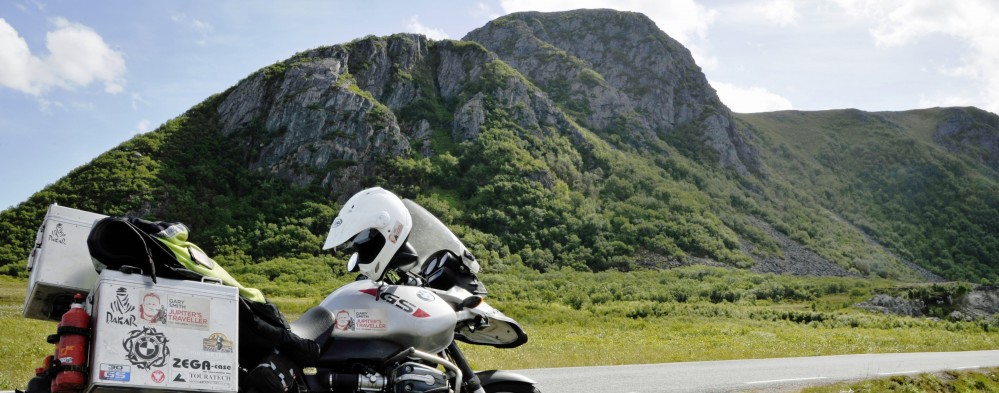
Replacing my old R1150GSA was never going be easy, we have collectively covered in excess of 136,000 miles and both have battle scars of drops and dings from the past 10 years together collected from city tours and long solo trips to Scandinavia, eastern Europe and more social trips to Italy and the south of France. My travels have been recorded and published as poems, stories and photoblogs all with the backdrop of a grey well worn BMW.

Africa Twin on the EpyntIn 2014 when the Africa Twin replacement was first shown by Honda as a concept bike it was an intriguing — a 1000cc, tubeless, chain driven, tall and narrow offering and personally not wanting to swap one heavy boxer for another I decided to look for something different and having borrowed and test ridden a number of other potential replacements, I finally settled on a CRF1000 and perhaps for me the most revolutionary elements was the D or the DCT twin clutch semi-automatic box. But, one word of warning if you want to be inconspicuous at the moment do not ride around on a Red Africa Twin, in fact any Africa Twin at the moment is attracting a lot of interest.

The new model was showcased at the NEC in November 2015 and since then deliveries into the UK have been slow but steady and a few manual bikes have made it onto the road but very few DCTS – so in essence what is the bike like to ride?

In a word “easy”. Honda has managed to design a new engine which is a liquid-cooled 4-stroke 8-valve Parallel Twin with 270° crank and uni-cam with a bore and stroke of 92.0 x 75.1 mm giving a capacity of just under one litre at 998cc. Power is modest at just under a claimed 94bhp @ 7500 rpm and almost 100Nm of torque which in day to day riding makes the bike really easy to ride as the pickup very swift and easy to use.

The bike feels tall, I think no doubt helped by the narrowness and if like me, you move from a boxer twin you will immediately noticed the change — filtering in traffic is easy and the DCT makes that whole experience easier as you balance the throttle and rear brake to maintain forward movement at very low speeds.

The most significant change is now doubt the DCT. My last automatic was a ‘step through’ 90 so this was always going to be an improvement. The gearbox has a fully manual mode or the option of automatic with flappy paddle asset or fully automatic (D Mode) all with selectable multiple stage traction control and power modes and a G Mode button… Day to Day D mode is default, switching the power modes does not increase the BHP but rather allows the gearbox to hold onto gears for longer and higher in the rev range — the bike is certainly quick off the lights. Off road the G mode activates a number of additional accelerometers and inclinometers which hold the selected gear for longer and the bike does not change gear unexpectedly on descents or traversing muddy and gavelled tracks — for me as an average off road rider it certainly inspires confidence and I have tackled tracks and lanes I would not have considered on my GSA in a wet and wild Welsh winter.Africa Twin on the Epynt

The front brakes are powerful non servo assisted (which is a positive benefit from my old BMW) 310 mm dual wave floating hydraulic discs with aluminium hubs and radial fit 4-piston callipers fitted with sintered metal pads and the rear is a smaller 256 mm wave hydraulic disc with 2-piston calliper and sintered metal pads. The ABS is switchable dual channel and very intuitive and the rear can be turned off which is essential when you are off tarmac and you actually want to lock up the rear wheel. The DCT is also fitted with a parking break on the LHS which is far enough away so you cannot ever mistake it for a clutch lever. Hill starts just require a slight change in technique in balancing rear break and throttle… the same as slow speed filtering.

Perhaps most controversially Honda have fitter a combination of tubed tyres with a 21” front (90/90) and a 150/70 18” rear — the bike comes fitted with Dunlop TrailSmart which are adequate, but not confidence inspiring and prone to twitching in the wet, on overbanding and metal access covers in the roadway. Within another 1500 miles they will be due for replacement having got 4000 from the OEM rear.

Accessories for the bike are slowly filtering through with Rugged Roads and Touratech offering a number of enhancements and replacement smaller panniers and a modest top box are being fitted to support longer solo trips – I have shelved my very old Zegas on the basis they add too much width to the bike and defeat the narrowness advantage and a PDM60 and Scottoiler have been fitted to help distribute power to my Zumo 590 and avoid the need for tins of spray lube to be carried.

Six weeks have flown past, she has been dropped in the mud, I have broken one brake lever, lost or broken some of the plastic and captive bolt trim fixings… indeed disassembling and replacing the plastic trim takes care and a methodical approach. I am looking forward to putting some more miles on the bike with ferry crossings already booked. Is the new Africa Twin a GS replacement? Yes, for me it is, I do not yet have the same feelings for it as I do my old GSA but that trust has to be earned. The reliability of the technology has yet to be proven but Honda’s reputation for excellent build quality and support help allude any niggles and three years EU breakdown cover comes with the bike — my old GSA now sits in my garage, covered and cosseted – I had forgotten and have certainly forgiven the times she left me stranded with servo or fuel pump failures, its time for me to change and embrace a brave new world of DCT G Mode on a lighter more nimble bike – roll on the next 100,000 miles.